Showing posts with label History. Show all posts

Wednesday, March 21, 2012

The Gadsden Flag and the Navy Jack


Maybe you recognize the flag above. It's known as the Gadsden Flag, and was first mentioned in 1775 when it was painted on the drums of U.S. Marines. There was some sentiment that the rattlesnake should become the national symbol of America instead of the Eagle. Among the reasons given were: because he never starts a fight without provocation, gives clear warning that his anger is aroused, yet never surrenders once the fight begins. If you look carefully at a full-sized flag, you would find that there are thirteen rattles on the snakes tail, one for each of the original states.

The original Gadsden Flag was presented to the first Commodore of the U.S. Navy by Colonel Christopher Gadsden, and was used as Commodore Hopkin's personal standard (flag) on whatever ship he was aboard.

A variation of the flag was adopted by the Navy and every ship flew it in addition to the U.S. flag. It's now known as the First Navy Jack.


Eventually, it became naval custom for the ship with the longest period of active service in the navy to fly the First Navy Jack. In 2009, the aircraft carrier USS Enterprise recieved that honor upon the decommissioning of the carrier USS Kitty Hawk.

Flag images courtesy of www.Gadsden.Info and www.NavyJack.Info, along with much of the information included above. Follow those links for more related history.

Wednesday, March 14, 2012

Superstitions: Salt, Garlic, and Silver Bullets

(Cross-posted to Jennifer's History and Stuff.

Salt and garlic have long been used throughout the world for medicinal and preservative purposes, and as a result generally have "lucky" reputations.

For example: if you spill salt, take a pinch and throw it over your left shoulder to avoid bad luck. The earliest record of this practice dates from around 1584; it was seen quite commonly thereafter. Why do people do this? The reasoning is largely unknown. Some people say the Devil whispers in your left ear and the salt will blind him or drive him away. (As for why spilling salt is unlucky in the first place, this is due to salt's historically high value.)

An older salty superstition said that keeping a bag of salt with a baby before baptism guarded the child against witches. This practice arose at least partly because salt was mentioned in the Bible for use in the baptismal ceremony, and was used in pagan ceremonies long before that.

Garlic also has a history of use as a protectant. The protection against vampires sprang from literature. (See: Dracula, 1897.) Before this, however, it was used to protect against witchcraft everywhere from Europe to Asia.

And since we're talking about modern-day monsters, how about silver bullets? Long before they stopped vampires and werewolves, they were believed to be the only thing that could harm a witch who had taken the form of a rabbit or other animal. Silver itself has a long history of being used for luck, because of its value in general. It is supposedly able to withstand enchantment, which is why it can't be deflected by evil beings.

Reference: Most of the material from this post was found in David Pickering's Dictionary of Superstitions and Steve Roud's The Penguin Guide to the Superstitions of Britain and Ireland.

Wednesday, February 29, 2012

Superstitions: Walking Under Ladders

Cross-posted at Jennifer's History and Stuff.

The superstition that walking under ladders is bad luck is fairly widespread. In America and Europe, this belief originated around the late 1700s.

There are a few theories as to the original thought behind this superstition. The first is that a ladder leaning against a wall forms a triangle--or trinity--with the ground. Walking through this triangle is disrespectful to God and may show your sympathy to the Devil.

Alternatively, any ladder can represent the ladder used to remove Jesus from the Cross, under which the Devil lurks. You don’t want to go where the Devil hangs out, now do you?

Whatever the origin of the superstition, there is a practical reason not to walk under ladders: you might get hit by something falling from above.

Reference: Most of the material from this post was found in David Pickering's Dictionary of Superstitions and Steve Roud's The Penguin Guide to the Superstitions of Britain and Ireland.

Wednesday, February 15, 2012

The Winchester Mystery House

In San Jose, California, you can tour one of the strangest buildings in the world - the Winchester Mystery House. Sarah Winchester, the wealthy widow of arms magnate William Winchester, believed that the spirits of all those killed by her husband's rifle would haunt her unless she appeased them by constructing a home for them all. In 1884, she bought a farm in San Jose and began construction of a home, the likes of which the world had never seen before.

Construction on the mansion continued around the clock, every single day for 38 years, until the day she died. Often Sarah would hand her carpenters plans that she had drawn up the night before. There was no master plan to be followed, and eventually the house stood seven stories tall and was full of eccentric oddities like stairways and doors to nowhere. Some were supposedly designed to confuse the ghosts, hallways that dead ended and the like, to keep Sarah safe in her own home. Others were practicalities that only an incredibly rich eccentric could afford, such as a stairway with 40 steps, each only 1 inch tall, built late in her life because she had debilitating arthritis and could only raise her feet a few inches. Sarah was also obsessed with the number 13, and that number turns up constantly throughout the home. Newly hired servants were given maps of the house so they could find their way around without getting lost.

As odd as she may have been, Sarah Winchester had exquisite taste, and in many ways the house was ahead of its time. There were modern conveniences like a hot shower, forced air heating and electric lighting. During the 1906 San Francisco earthquake, Sarah Winchester was trapped in her bedroom for several hours. After the earthquake, the top three stories were removed and today the mansion is only four stories tall.

Tours of the mansion are offered daily, and here's the official website of the Winchester Mystery House.

Tuesday, July 1, 2008

Superstitions: Gesundheit!

gesundheit.jpg
(Click to enlarge.)

Saying “God bless you” or “Gesundheit” in response to someone’s sneezing is extremely common throughout Europe and America. “Gesundheit” simply means “health”, and a post-sneeze wish for good health is found even in the writings of Pliny the Elder.

This early mention of the practice disproves the widespread belief that “God bless you” originated during the 17th Century Plague, when sneezing was supposedly a symptom. The earliest reference in England dates to 1483; also well before the Great Plague.

Superstitions around sneezing probably originated with the earliest people, who may have thought this little explosion in the head was some sort of sign from the gods. Some people still believe that sneezing leads to a temporary deprivation of the soul, with “God bless you” returning the soul to the body.

Reference: Most of the material from this post was found in David Pickering's Dictionary of Superstitions and Steve Roud's The Penguin guide to the superstitions of Britain and Ireland.

Monday, June 2, 2008

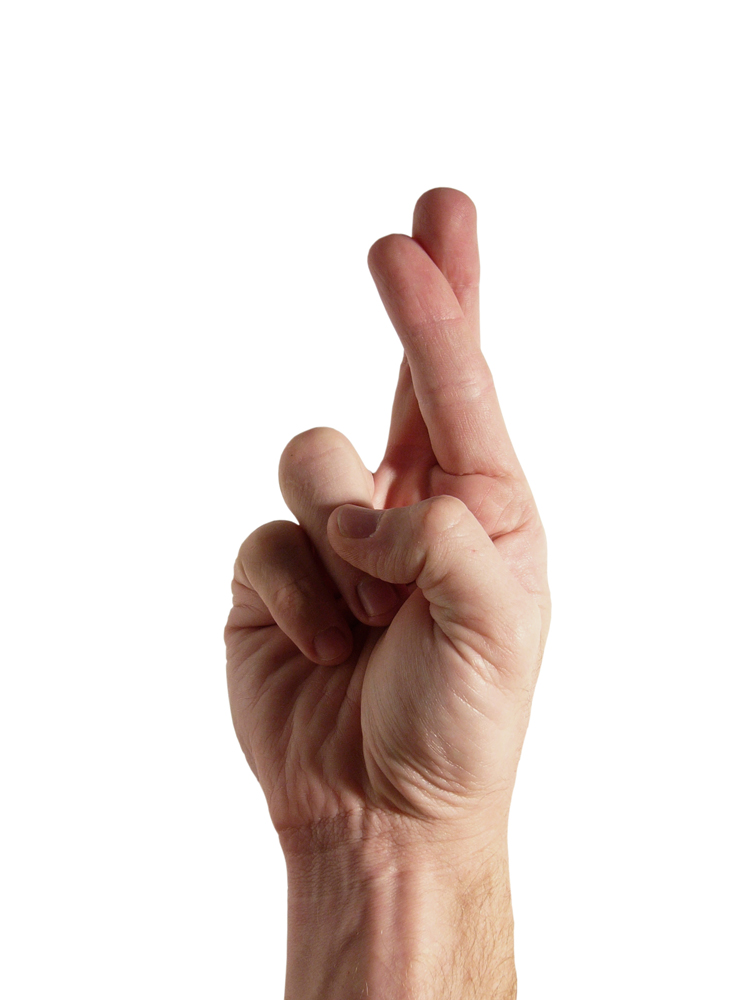
Superstitions: Crossing Your Fingers

crossed-fingers.jpg

Crossing your fingers can give you good luck, ward off bad luck (like, say, when you have to walk under a ladder), and protect you from the consequences of a lie.

This practice is seen in America, Britain, and some parts of Scandinavia. The earliest reference found dates only from 1890, so it is surprisingly new. Before this, it was more common to clench the thumb with the fingers

So why cross your fingers at all? Once again, we can look to Christianity for the origins of this one: some people believe crossing your fingers makes the sign of the crucifix, which of course has the power to ward off evil.

Reference: Most of the material from this post was found in David Pickering's Dictionary of Superstitions and Steve Roud's The Penguin Guide to the Superstitions of Britain and Ireland.

Monday, May 12, 2008

Superstitions: Walking Under Ladders

Cross-posted at Jennifer's History and Stuff.

The superstition that walking under ladders is bad luck is fairly widespread. In America and Europe, this belief originated around the late 1700s.

There are a few theories as to the original thought behind this superstition. The first is that a ladder leaning against a wall forms a triangle--or trinity--with the ground. Walking through this triangle is disrespectful to God and may show your sympathy to the Devil.

Alternatively, any ladder can represent the ladder used to remove Jesus from the Cross, under which the Devil lurks. You don’t want to go where the Devil hangs out, now do you?

Whatever the origin of the superstition, there is a practical reason not to walk under ladders: you might get hit by something falling from above.

Reference: Most of the material from this post was found in David Pickering's Dictionary of Superstitions and Steve Roud's The Penguin Guide to the Superstitions of Britain and Ireland.

Friday, April 25, 2008

Superstitions: Horseshoes

Cross-posted to Jennifer's History and Stuff.

In the late 1300s, we see the first British record of a found horseshoe being considered lucky. This belief has been held by pretty much every horseshoe-producing culture, from Scandinavia to Asia. The key was to have a found horseshoe, rather than a new horseshoe, and various degrees of luck were associated with intact nails, number of nail holes, etc.

By the late 1500s, the English were nailing their found horseshoes above their doors to keep the witches at bay. This is probably related to a long-held belief in the power of iron, which protected European people from fairies and other spirits before witches came along.

As we got closer to 1900, horseshoes above the door were less about witches and more for general luckiness. Whether the horseshoe’s ends should face up or down has never been completely resolved. Some people think facing the ends up will keep the luck from falling out of the horseshoe, while others believe facing the ends down will direct all that luckiness to the people walking below it.

Reference: Most of the material from this post was found in Christina Hole's The Encyclopedia of Superstitions and Steve Roud's The Penguin Guide to the Superstitions of Britain and Ireland.

Tuesday, April 15, 2008

Superstitions: Salt, Garlic, and Silver Bullets

(Cross-posted to Jennifer's History and Stuff.)

Salt and garlic have long been used throughout the world for medicinal and preservative purposes, and as a result generally have "lucky" reputations.

For example: if you spill salt, take a pinch and throw it over your left shoulder to avoid bad luck. The earliest record of this practice dates from around 1584; it was seen quite commonly thereafter. Why do people do this? The reasoning is largely unknown. Some people say the Devil whispers in your left ear and the salt will blind him or drive him away. (As for why spilling salt is unlucky in the first place, this is due to salt's historically high value.)

An older salty superstition said that keeping a bag of salt with a baby before baptism guarded the child against witches. This practice arose at least partly because salt was mentioned in the Bible for use in the baptismal ceremony, and was used in pagan ceremonies long before that.

Garlic also has a history of use as a protectant. The protection against vampires sprang from literature. (See: Dracula, 1897.) Before this, however, it was used to protect against witchcraft everywhere from Europe to Asia.

And since we're talking about modern-day monsters, how about silver bullets? Long before they stopped vampires and werewolves, they were believed to be the only thing that could harm a witch who had taken the form of a rabbit or other animal. Silver itself has a long history of being used for luck, because of its value in general. It is supposedly able to withstand enchantment, which is why it can't be deflected by evil beings.

Reference: Most of the material from this post was found in David Pickering's Dictionary of Superstitions and Steve Roud's The Penguin Guide to the Superstitions of Britain and Ireland.

Wednesday, April 9, 2008

Superstitions: Throwing Rice at the Bride and Groom

(Cross-posted at Jennifer's History and Stuff.)

Some superstitions may have lost their original meaning, but have become ingrained in cultural behavior. These behaviors are no longer tied to a superstitious belief; throwing rice is one of these behaviors that simply became part of the culture. Of course, now you are more likely to see bubbles, flower petals, or birdseed at a wedding in the United States, but most of us have pelted a bride and groom with rice at one time or another.

The earliest known reference to throwing grains at a wedding occurred when a baker’s wife tossed wheat at Henry VII for good luck in 1486, and it became a widespread practice in England soon thereafter. The switch to rice took place around 1870, probably because rice was cheaper than wheat at the time.

Why throw anything? The Victorians liked to say it was to ensure fertility, but it was generally just to wish the new couple lots of luck, happiness, and prosperity. Using foodstuffs as good luck charms is not confined to weddings. We'll discuss salt and garlic another time.

Reference: Most of the material from this post was found in Steve Roud's The Penguin guide to the superstitions of Britain and Ireland.

Superstitions: Knock on Wood

(Cross-posted at Jennifer's History and Stuff.)

If you say something to tempt fate, knocking on wood will protect you. (Example: "I'm the only one in my house to not get the flu. Knock wood.")
This superstition can be traced to the early 1800s, with some people believing it invokes the wood of the crucifix for protection.

The real origin seems to be a children’s game from the early 1800s called “Tig-touch-wood”. Children playing tag were “safe” when they touched wood. Touching wood for luck became knocking on wood for luck in the U.S. and Germany.

Reference: Most of the material from this post was found in Steve Roud's The Penguin guide to the superstitions of Britain and Ireland.

Wednesday, April 2, 2008

Superstitions: The Number 13

(Cross-posted at Jennifer's History and Stuff.)

The number 13 is thought to be an unlucky number, with some people refusing to live in a house numbered 13 or stay on a hotel floor numbered 13.

Why?

Well, around 1700, the belief that having 13 people at a meal was unlucky was fairly widespread. Therefore, the number 13 must be unlucky because of the Last Supper, right? After all, 13 people participated in that, and one was dead soon thereafter.

But actually, early Christians loved to emulate J.C., and that included organizing themselves into groups of 13. You'd have 12 nuns and their superior, for example, making a group of 13. The number 13 was awesome!

So what happened? A little thing called the Protestant Reformation, actually. During the Reformation, the obsession with groupings of 13 was itself called "superstitious", and the practice was forbidden.

This led to the number 13 immediately having a "bad" connotation that turned into unlucky over the years...becoming its own superstition!

Reference: Most of the material from this post was found in Steve Roud's The Penguin guide to the superstitions of Britain and Ireland.

Thursday, October 4, 2007

The Space Race

Fifty years ago today, the Space Race was won, but the Soviet Union. The USSR launched Sputnik, a small, simple satellite whose continuous beeping announced to the world their victory.


Three and a half years later, on 12 April 1961, the USSR would take the next step into space, when Senior Lieutenant Yuri Gagarin travelled into space aboard Vostok 1 (while in orbit, he was promoted to the rank of Major).


(Please ignore the obnoxious soundtrack in this video.)

The United States would put Alan Shepard into space less than a month later.

Tuesday, August 21, 2007

How People Lived: The Dial Telephone

Several years ago, I used to babysit my old roommate's son, Matt. He and I always got along well and I was happy to do so. One day, I was babysitting him and he had to contact his mom, so I showed him my telephone.

It was an old, wall-mounted rotary dial telephone that had conveyed with my condo. As Matt was six or seven at the time, he had never seen a dial phone before and he looked at it as if it were ancient technology...which, of course, it was. Fortunately, my girlfriend was with us, and she let him borrow her cell phone, which he dialed as if he had been using one all his life.

Which, of course, he had.

It wasn't always like that. I'm sure you've seen the old movies/tv shows where someone holds an earpiece to their ear, turns a crank several times, and yells into the wall-mounted microphone, "Operator! Get me..." and they'd give a number...or probably a city, which would connect you to a party line and the fun would really start.

In the 1920's, the phone company started to do away with the crank phones and introduced dial phones...but like Matt, no one knew how to use one.

At midnight on Saturday, May 28, 1927, the city of Fresno was converting to dial telephones, so the phone company released this public service announcement to the local theaters, to teach people how to use that brand-new piece of equipment...the dial telephone.

Sunday, August 19, 2007

C & O Canal

Construction on the Chesapeake & Ohio Canal began in 1828 in Washington, D.C., although the idea for a navigable waterway from the Potomac to the Ohio Valley was envisioned as early as George Washington's time. The 184.5 mile canal was completed in 1850, ending in Cumberland, Maryland, and for nearly 75 years it was a major route for moving coal (850,000 tons in 1871). Flooding was always an issue, however, and since the railroad had moved in by then, in 1924 the canal ceased operations following another flood.

In the 1930's, restoring the lower section of the canal was a Civilian Conservation Corps project, in anticipation of the canal becoming a national park. The canal itself only survived because of Supreme Court Justice William O. Douglas, however. In the 1950's the plan was to turn the canal into a parkway to allow motor access through the park, and Justice Douglas, an avid hiker, wrote a letter to the Washington Post
arguing for preserving the canal:

One who walked the canal its full length could plead that cause with the eloquence of a John Muir. He would get to know muskrats, badgers, and fox; he would hear the roar of wind in thickets; He would see strange islands and promontories through the fantasy of fog; he would discover the glory there is in the first flower of spring, the glory there is even in a blade of grass; the whistling wings of ducks would make silence have new values for him. Certain it is that he could never acquire that understanding going 60, or even 25, miles an hour.
He even organized a hike of editors and conservationists, sucessfully swaying public opinion away from the road and back to nature. Time reported on April 5, 1954:

By the time he was ten miles from the city, Douglas had 50 followers, and was being paralleled in the canal by canoeists bearing such signs as SAVE THE CANAL and LESS CARS-MORE CANOES !

The long walk ended at an old canal lock a quarter of a mile farther along. A National Park Service sightseeing barge, drawn by two mules, awaited the hikers. They climbed aboard to ride the last five miles to Georgetown. Their triumphal entry into the city, however, was just beginning. As the barge sloshed down the canal, hundreds of men, women & children hustled along the banks exchanging greetings with the expedition. Other well-wishers called greetings from overhead bridges. The escorting fleet of canoes grew. Automobiles jammed up along a parallel roadway.

The 12,000 acres, including the canal and towpath rather than a paved road, became a national park in 1971.

Here are a few pictures from the section of towpath closest to where I live:


This may be a reproduction, or perhaps a replacement, lockhouse. On the other side of the canal you can see the stone foundation of another building.


The canal at Lock 26.


The store at White's Ferry records the high water marks after the Potomac River floods. (This is the second story of the building.)


The Monocacy Aqueduct

Monday, August 13, 2007

Bernard Smith: An Amazing Life

Bernard Smith was born in 1910 in New York City. By age 22, he had dropped out of high school, working odd jobs and spending most of his time at the libraries and museums of the city.

One night, he attended a meeting of the American Rocket Society and while looking over one of their failed rockets, made some suggestions on how to improve the device. The president of the Society, Edward Pendray, handed him the pieces of the rocket and invited him to create the next version.

According to Smith, his motivation was simple. America was in the midst of the Great Depression, and "It was a lousy planet. The rocket ship was the only way to get off it."

After making major modifications to the original rocket design, including several weight-saving changes, the new rocket was ready to fly in early 1933. It wasn't entirely successful, but proved that the basic concepts were sound.

Bernard Smith never did graduate from high school, but he did earn a degree in Physics. In fact, after World War II he started his career working for the US Navy, eventually heading up the Weapons Development Department at the Naval Ordinance Test Station. Among the projects that he worked on or managed are the ASROC, Sidewinder and Shrike. He also spearheaded Project Pilot, which placed at least one small satellite into orbit via air-launched rockets in 1958.

So that's the "rocket" side of Bernard Smith. But there's more, for there's the "sailboat" side of Bernard Smith.

Smith also spent over 40 years pursuing his dream of creating the perfect sailboat. He tried many unconventional designs and met some notable successes. In fact, one of his early efforts, the Aerohydrofoil, could make 20 knots in a 12 knot wind. He also designed craft he called Monomarans, Fliptackers, and experimented with a concept called the Sailloon, which was a gas-filled sail that would help provide lift, and thus speed, to a sailboat.

Follow that link above for a fascinating look at the creations of a mind who saw radically different, and sometimes better, ways to accomplish his goals, both through the air and on the water.

Sunday, August 5, 2007

Naming Boats That Sink On Purpose (part 1)

My son served a tour in the navy on the submarine USS Philadelphia. One night I got to wondering about the method the US uses to name its' subs. Here’s a little bit about what I found.

Before WWII, all US subs were numbered by type, so you had the O-25, the R-14, and the S-12. Militarily efficient, but not very inspiring.

In WWII, US submarines were named after fish and marine creatures. So we had cool scary names like the Barracuda, Stingray, and SeaDragon. We also had some less-than-fearsome names like the USS Plunger, the USS Tuna, and USS Cod. We had a lot of submarines in WWII, and I guess we ran out of good names.

Since then, the Fast Attack boats have been named according to evolving custom, starting with the same fish and marine creatures, then moving on to Presidents, Admirals, and important Americans, for a while cities and towns, and most recently to States (which used to be what we named Battleships for).

For the ‘boomers’ (missile boats), the evolution was from Presidents, to Distinguished Americans, and now States of the Union. There was a time when you knew a ship’s function by it’s name; the Iowa and Texas were battleships, the Helena and Indianapolis were cruisers. It's not that cut and dried anymore.

While poking around, I saw among the USN Ballistic Missile Submarine force the Lafayette (SSBN 616), Tecumseh (SSBN 628), Von Steuben (SSBN 632), Casimir Pulaski (SSBN 633), Simon Bolivar (SSBN 641), and the Mariano G. Vallejo (SSBN 658). There is also a Fast Attack boat named the Kamehameha (SSN 642). Not all of these boats are still in service, the average lifespan of US submarines appears to be around 30 years.

The names may be familiar to you, in a vague sort of way. But what did these people do that was important enough for the navy to name ships (er, boats*) after them? Click on the names for more complete biographies.

Lafayette
The Marquis de Lafayette was a French soldier and statesman who played an important part in the American Revolutionary War.

Tecumseh
One of the great leaders of the American Indian tribes. A member of the Shawnee, he worked to unite the Indian nations against the encroaching white man.

Von Steuben
Friedrich Wilhelm Augustus von Steuben was a Prussian soldier who came to America to help in the war against Britain. He was instrumental in turning Washington’s ragtag band of revolutionaries into an army, introducing techniques of training that are still used today.

Casimir Pulaski
Polish officer who is known as the Father of American Cavalry, he helped organize and train troops for General Washington. He trained the father of Robert E. Lee in Cavalry tactics.

Simon Bolivar
This one has me a little stumped. Basically his claims to fame – as far as the US Navy is concerned – are that he traveled through the US soon after the war of independence, which may have inspired him to liberate South America. He is sometimes called the ‘George Washington of South America’. I’ll keep looking for the tie-in, unless ‘prominent Americans’ extends to the whole of the Americas (USS Carmen Miranda anyone?).

Mariano G. Vellejo
Born in Mexico, he considered himself a Californian above all else. He played an important part in the development of the California territory and it’s eventual inclusion into the United States.

Kamehameha
A dynasty of Hawaiian monarchs. I always thought it was just one King. I would guess that the submarine is named after the first Kamehameha, who was known as "the Great".

I’ll be looking up some of the other, less well-known historical figures later and I’ll link to their biographies as well.

* In the US Navy, all large surface vessels are referred to as ships but all submarines are called boats.

Friday, August 3, 2007

Drawing water up a hill


I like thinking about the world before electronics. Not that I'd like to return to those days, but the machines invented to perform tasks in the world of mechanics are sheer brilliance. Probably topping the list of really cool mechanical machines is the machine known as Archimedes Screw.

Archimedes Screw enables water to be drawn up hill (or to irrigate some Hanging Gardens that might be hanging around the city of Babylon). How does it work? Well, you turn the screw and the water flows up the screw. The simple machines that you learned about in elementary school? Well, here is where they matter. The screw is an inclined plane wrapped around a cylinder. As the screw turns, it scoops up water. This water is pushed up the incline (around the cylinder) until it finally pours out from the top, feeding an irrigation system.


Does such a mechanical system still have value in today's world? Of course! Not only is it fun to create your own irrigation system from the local creek (a fun weekend project), but such systems are of wide use in the world - from the developed world (where Archimedes Screws are used in sewage treatment plants - like the one in Memphis, TN, shown above) to the undeveloped world needing cheap, available irrigation (shown below)


For more on Archimedes Screw (and his other wonderful inventions), check this out.

Thursday, August 2, 2007

The Seven Wonders


You've probably heard about the recent voting for the "new 7 wonders." The expressed aim of the project was to call attention to world heritage and I hope that it does this. We all have an interest in preserving the heritage of the world. It is important to note, however, the difference between these wonders and the canonical Seven Wonders of the Ancient World.

The Wonders of the Ancient World are initially due to Herodotus. He compiled his list of places he saw as he traveled around the Mediterranean. Destroyed with the Library of Alexandria, Callimachus of Cyrene compiled a collection of "Wonders around the World." They probably weren't finalized in what the wonders are now known as. It wasn't until the Middle Ages when the canon of the wonders were drawn to what it is known as now (they weren't, as the press releases of "The New 7 Wonders" suggest, decided by one man).

The Wonders of the Ancient World were, apparently (only one - The Pyramids at Giza - survives), truly wondrous to behold. A wonderful reference on the seven wonders is located here. They are:

  1. The Pyramids of Giza
  2. The Colossus at Rhodes
  3. The Hanging Gardens of Babylon
  4. The Mausoleum at Halicarnassus
  5. The Temple of Artemis at Ephesus
  6. The Statue of Zeus at Olympia
  7. The Lighthouse at Alexandria

I've traveled a decent amount and been to a lot of different places in the world. However, I have only been to one of the so-called "New 7 Wonders." In all honesty, two of them I don't think belong on the list at all. I find it interesting that none of them is built in modern times. I wonder about that - do we build physical wonders anymore (as a culture)? The same website has a list of seven modern wonders and seven forgotten modern wonders. I've seen seven of those fourteen and I just don't feel like those really rise to the level of wonder. What do you think? Any thoughts on what modern wonder you think will make it to the canon and be discussed 2000 years from now?

Friday, July 27, 2007

Moon Trees

During the Apollo missions that landed on the moon, one member of each crew stayed in orbit while the other two descended to the surface. One of these Command Module Pilots was Stu Roosa, who was a smoke jumper before he became an astronaut. Besides photographing the moon from orbit and performing other scientific experiments, Roosa carried with him 500 tree seeds. The idea was to plant them when he returned to Earth and to watch over time to see what effect the trip into space might have on them.

Over 400 seedlings were grown from the seeds, and they were planted in various places around the US and the world. If you follow this link to the Moon Trees page, you'll find a list at the bottom showing where many of them are planted.

Maybe one is close enough to you to visit. After all, not every tree went around the moon and back!